A Family Gathering, One Story Worth Carrying Home
A family gathering story can stay vivid without a full recap. Use a gentle weeklong ritual to record one meaningful phrase and let it guide a later choice.
Which moment from the family gathering do you want to remember when the dishes are put away and the room has gone quiet? A family gathering story can be a small detail: an uncle’s description of learning to bake, a cousin’s phrase about starting over, or the way a familiar tale changed when someone new joined in. A gentle weeklong ritual helps you keep one moment without turning the evening into a transcript or claiming to speak for everyone.
Choose one thread
Before you leave, or once you are home, notice what keeps returning to mind without forcing a choice. It might be a story you had never heard, a phrase that made you laugh, or a pause that changed the feeling of a conversation. You do not need to decide whether it was the most important moment of the gathering. Choose the one you personally want to carry.
Keep the selection modest. The aim is not to account for every conversation, settle who remembered the past correctly, or preserve the family’s official version of an event. It is to make a small record of what reached you. Like choosing one postcard from a crowded drawer, you are keeping a particular view, not the whole trip.
If several moments compete, ask yourself which one you can still picture or hear. A line spoken while pouring tea may be more useful to remember than a long discussion whose details have already blurred. Let the answer be yours, rather than a judgment about what other people should value.
That first evening
On the evening of the gathering, make a brief private note while the details are close. A paper notebook, a notes app, or a voice memo can all work; choose the one you are comfortable keeping. Write the date and a few cues about the setting, then record the story or phrase as you remember it.
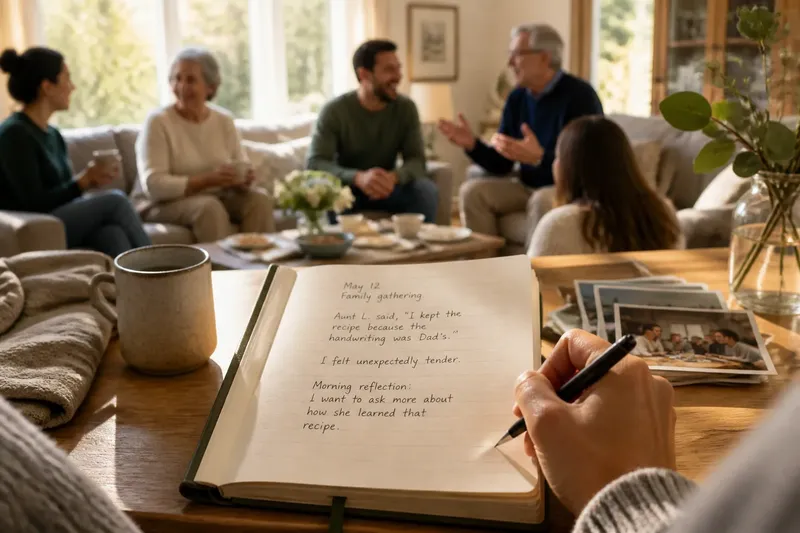
Separate the words you recall from your response to them. For instance: “She said, ‘I kept the recipe because the handwriting was Dad’s.’ I felt unexpectedly tender.” If the wording is uncertain, say so: “Something like…” or “I remember the thought, not the exact line.” That small distinction protects the record from turning a hazy recollection into a supposed quotation.
Keep the note short enough to finish without reconstructing the whole event. A few lines can hold the speaker, the moment, and why it stayed with you. Leave out details that do not help you recognize the scene later, especially private information you would not want another person to read.
The next morning
When you look at the note the next morning, add only what has become clearer: where people were sitting, what happened just before the story, or why a particular phrase sounded different in that room. Do not fill gaps by guessing. If you are unsure whether someone said “always” or “often,” mark the uncertainty rather than choosing the more dramatic version.
Then write one sentence about what the moment may mean to you now. Keep it in the first person: “I want to ask more about how she learned that recipe,” or “I noticed how much I enjoy hearing the ordinary parts of his childhood.” This is an opening for your own reflection, not a verdict about what the speaker intended.
If your response involves another person’s difficult experience, let the note stay private for now. A meaningful story is not automatically yours to repeat. If you later want to quote or share someone’s words, ask them, particularly if the details are personal or the audience will be broader than the family room.
During the week?
What if I remember the story differently?
Record your version as a memory, not as a final account. Use a phrase such as “as I remember it” and leave room for someone else to recall the scene another way.
Should I contact the person who told it?
Send a message if there is a genuine reason to continue the exchange, such as asking about a detail or saying what the story meant to you. A thank-you can be simple; you do not need to turn every remembered moment into a follow-up.
What if my note includes someone else’s private news?
Keep it in a private place and reduce the note to the part that matters to your reflection. Do not pass along sensitive details simply because they were shared at a family gathering.
What if nothing stands out?
Let the ritual pause rather than manufacture a meaningful moment. You can save a simple sensory detail, such as the familiar sound of everyone talking at once, or decide that this gathering does not need a written record.
Midweek, make room
At some point during the week, reread the note once. Ask what, if anything, you want to do with it. Perhaps you want to ask the speaker a question, write a few lines for yourself, or carry a small reminder into a choice you are already facing. The next action can be modest, and no action is required.
Say you wrote down a relative’s story about keeping a handwritten recipe because it connected her to someone she missed. You might decide to ask her, in a later conversation, what she remembers about that person’s cooking. The observable result would simply be a more specific question and a chance for her to answer or decline; it would not establish that your memory is exact or that she wants to revisit the subject.
If you do follow up, keep the invitation light and let the other person choose how much to share. “I’ve been thinking about the recipe story. Would you feel like telling me more about it sometime?” leaves space for a yes, a no, or a different subject. Avoid sending your interpretation as though it were the speaker’s intended lesson.
At week’s end
Near the end of the week, decide where the note belongs. You might keep it in a private journal, add it to a folder of personal memories, or delete it after the reflection has served its purpose. Choose storage that fits the sensitivity of the material and your own comfort. The record does not become more valuable simply because it is kept forever.
If you want to share the story in writing, make your perspective clear. “I remember hearing…” or “What stayed with me was…” signals that you are describing your experience, not speaking for the person who told it or for the whole family. Leave out names and identifying details when they are not needed, and ask permission before publishing someone else’s personal words or story.
For a phrase rather than a full story, preserve its context as well as the wording. Note who was present and what you think the phrase referred to, while labeling that interpretation as yours. A line can sound different outside the room; the surrounding moment helps you remember its texture without pretending that your reading is the only one.
Carry it forward
A family gathering story is useful to keep when it offers a gentle prompt for the life you already have: a question to ask, a connection to notice, or a reminder of what you want to value. It need not become a family archive or a polished piece of writing. Let it remain small enough to revisit without making it carry more meaning than it did.
When the next gathering comes around, you can begin again with one story or phrase, or skip the practice entirely. The point is not to collect a complete record of the people you love. It is to notice what you heard, mark the boundary between memory and fact, and choose with care what—if anything—you bring into the next conversation.